A well-chosen pipe clamp can still cause installation problems if the mounting method does not suit the equipment. Limited access to bolts, poor alignment, and weak brackets can slow assembly or create maintenance issues. Understanding pipe clamp mounting systems helps engineers design pipe routes that are secure, serviceable, and repeatable in production.
Variety Plastics offers ALFOMEGA horizontal, vertical, and rail-mounting pipe clamp categories alongside its broader DIN 3015-based clamp range. This guide explains how to evaluate the main mounting approaches and what to check before specifying components.
Why the Mounting Method Matters
A pipe clamp works as part of an assembly. The clamp body positions the line, while plates, fasteners, rails, and the machine structure transfer loads. The mounting arrangement affects how easily the line can be installed, inspected, and replaced.
The right method depends on orientation, available space, the number of lines, expected movement, and the supporting structure. Horizontal and vertical descriptions refer to installation arrangements, but the exact product geometry must be checked against the manufacturer's drawings. Do not assume every clamp can be rotated or interchanged without design review.
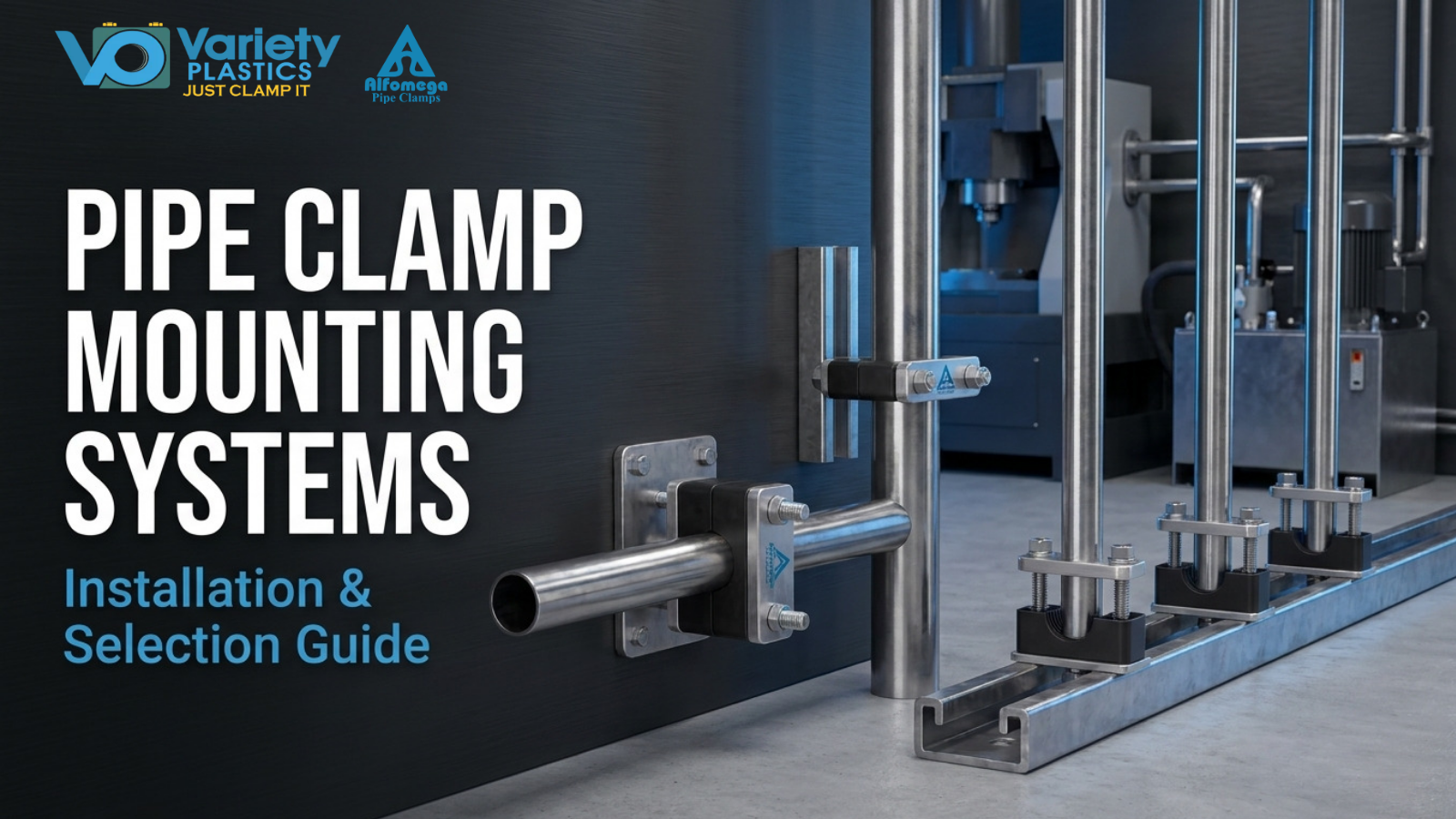
Horizontal Pipe Clamp Mounting
Horizontal arrangements are common where pipe runs follow machine bases, frames, or accessible support surfaces. They can make a route easy to inspect and may provide convenient access to fasteners when sufficient clearance is available.
Where horizontal mounting helps
Hydraulic power units, machine bases, and industrial pipe-routing panels often contain horizontal runs. A consistent support layout can simplify assembly and help maintain spacing between adjacent lines.
Design checks
Verify the supporting surface, bolt access, clamp height, and clearance from moving parts. Consider whether fluid leaks or cleaning liquids could collect around the mounting area. Where the equipment vibrates, inspect the stiffness of the mounting structure rather than focusing only on the clamp body.
Vertical Pipe Clamp Mounting
Vertical mounting arrangements are relevant when pipes or tubes travel up equipment frames, risers, or structural channels. They may help organize lines in tall or narrow machine layouts.
Where vertical mounting helps
Examples include machine columns, hydraulic risers, and process equipment with vertically routed lines. Vertical layouts can make efficient use of limited floor space, but they may introduce different access and load considerations.
Design checks
Evaluate the weight of the line and any contained fluid, the effect of gravity, thermal expansion, and maintenance access. A clamp intended to locate a line should not automatically be treated as a load-bearing anchor for the entire vertical run. Use appropriate engineering support and anchoring arrangements where required.
Rail Mounting Pipe Clamps
Rail-mounted systems use a compatible rail arrangement to position multiple clamp assemblies along a common support. This can be useful where line positions need to be organized or adjusted during equipment assembly.
Advantages of rail-based layouts
A rail can help create orderly routing for several lines and may reduce the need for individual mounting locations, depending on the design. It can also support repeatable layouts in machines built in batches.
Design checks
Check the rail profile, clamp compatibility, attachment method, rail stiffness, end restraints, and access for maintenance. Not all rails or clamp assemblies are interchangeable. Confirm the exact component family and hardware requirements before ordering.
Comparing Mounting Approaches
| Mounting approach | Typical layout | Main question to resolve |
|---|---|---|
| Horizontal | Lines along bases or panels | Is the surface strong and accessible? |
| Vertical | Risers or machine columns | How are gravity and line loads supported? |
| Rail | Multiple lines on a shared support | Are rail and clamp components compatible? |
The best arrangement may combine several methods across one machine. Design each location around the pipe route and its loads rather than insisting on a single mounting type throughout.
Installation Planning Checklist
Confirm the pipe outside diameter. The nominal size may not match the clamp bore. Measure or use the tube manufacturer's specified outside diameter.
Check the full bill of materials. Include the clamp halves, mounting plates or rail, cover plates, bolts, and other required hardware. Verify finishes and materials where corrosion is a concern.
Review access. A clamp that can be installed in the factory may be difficult to service after other machine components are fitted. Leave space for tools and line removal.
Consider movement. Thermal expansion, vibration, and frame flex can affect pipe runs. Avoid unintended rigid restraint and use the system designer's guidance for anchors and sliding supports.
Verify the mounting surface. A sound clamp assembly cannot compensate for a cracked bracket, inadequate fastener engagement, or an unsuitable support plate.
Follow approved tightening instructions. Do not invent torque values. Use the fastener and assembly specifications supplied for the exact product.
Common Installation Errors
Mistakes include mixing incompatible rail profiles and clamp hardware, ordering only the plastic blocks without the plates, placing clamps too close to service connections, and overlooking the weight of vertical runs. Another frequent problem is assuming that the same mounting arrangement will work after a pipe route has been modified. Update drawings and confirm clearances whenever the equipment changes.
Frequently Asked Questions
Are horizontal and vertical pipe clamps interchangeable?
Not necessarily. Check the product drawings, mounting geometry, and intended load direction before making a substitution.
When should I use rail mounting?
Rail mounting may be useful for organized multi-line layouts where compatible rail components and adequate structural support are available.
Can a pipe clamp support the entire weight of a vertical pipe?
Do not assume so. The system may need separate load-bearing supports or anchors designed for the actual weight and operating conditions.
What should I include in a mounting-system enquiry?
Provide line diameters, orientation, quantity, material preference, mounting-surface details, and any drawings or photos of the proposed installation.
Questions to Ask Before Ordering
A useful quotation request is more than a product name. Share the outside diameter of the pipe or tube, the number of lines, the installation orientation, the material preference, and the mounting surface. Include drawings or photographs when retrofitting an existing machine. If the assembly will face unusual heat, chemicals, salt exposure, shock, or repeated maintenance, explain those conditions rather than assuming a standard catalogue item will be appropriate.
For OEM orders, provide the expected quantity, desired delivery schedule, preferred hardware finish, and any inspection or documentation requirements. This information helps a manufacturer confirm availability and identify a suitable configuration. A clamp that fits dimensionally may still need a different material or mounting arrangement for the operating environment.
Why Work With Variety Plastics?
Variety Plastics manufactures industrial hydraulic pipe clamps in Sidhpur, Gujarat, India, under the ALFOMEGA brand. Its published range covers DIN 3015-based Light, Heavy, and Twin Series clamps, several clamp materials, mounting options, and protective accessories. For equipment manufacturers and industrial procurement teams, a focused product range can simplify discussions about repeat orders, dimensions, and application-specific requirements.
Instead of selecting by appearance alone, ask for the relevant technical drawing, available size range, assembly components, and material specification. Product suitability should be confirmed against actual service conditions. Explore the Variety Plastics product range or contact the team for a quotation. The publishing agent should replace homepage fallback links with the verified product and enquiry URLs.