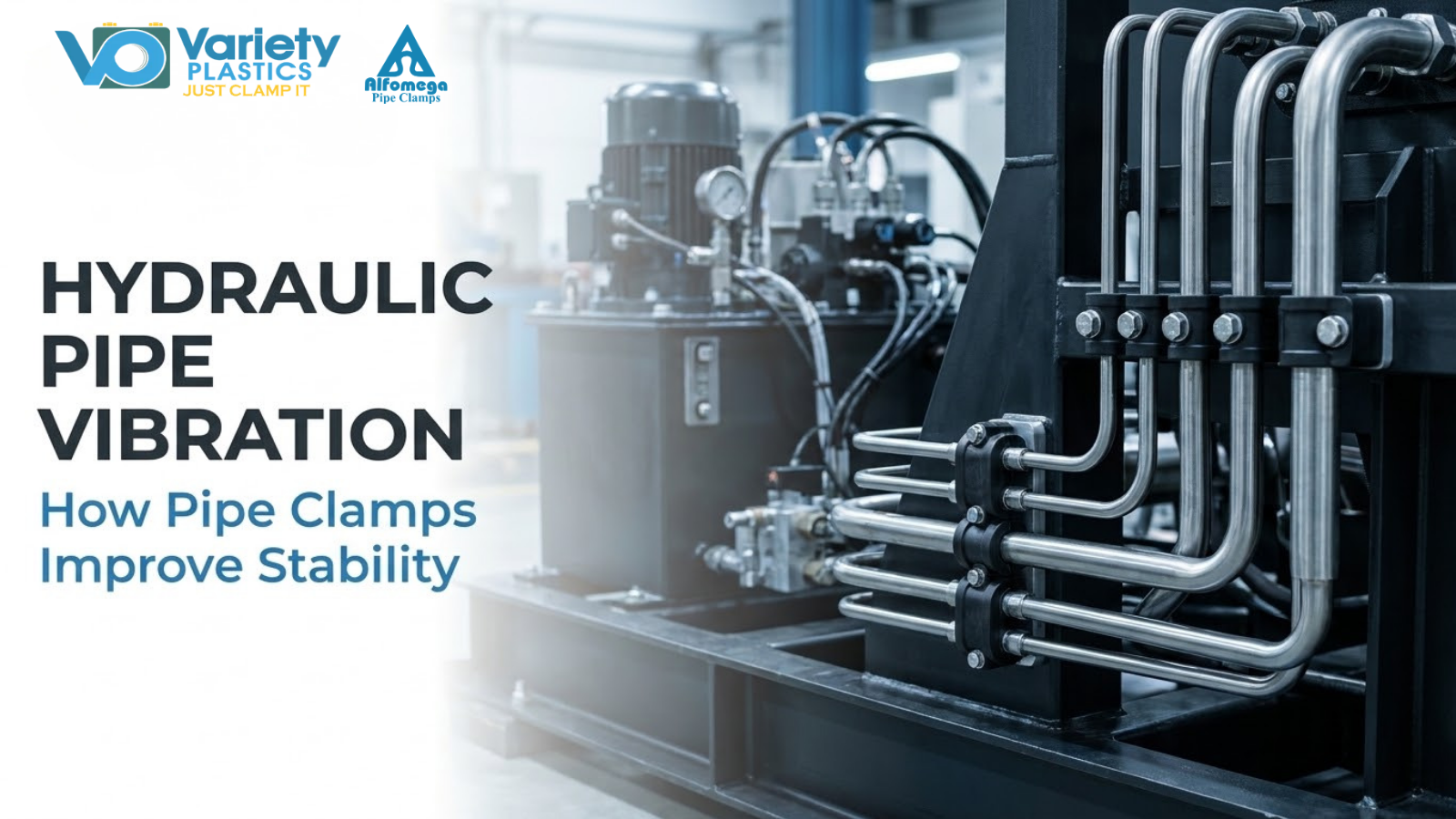
A hydraulic line can be designed with the right pressure rating and still become a maintenance problem if it is poorly supported. Tubes vibrate, hoses move, and tight equipment spaces make installation difficult. That is why engineers pay attention not only to the hydraulic circuit but also to the hardware holding it in place. DIN 3015 pipe clamps provide a widely used approach to arranging and securing pipes and tubes in industrial equipment.
This guide explains what the standard covers, how the major clamp series differ, what to check when choosing a size, and where material selection matters. It also shows how Variety Plastics, manufacturer of ALFOMEGA pipe clamps in India, fits into the procurement process.
What Is a DIN 3015 Pipe Clamp?
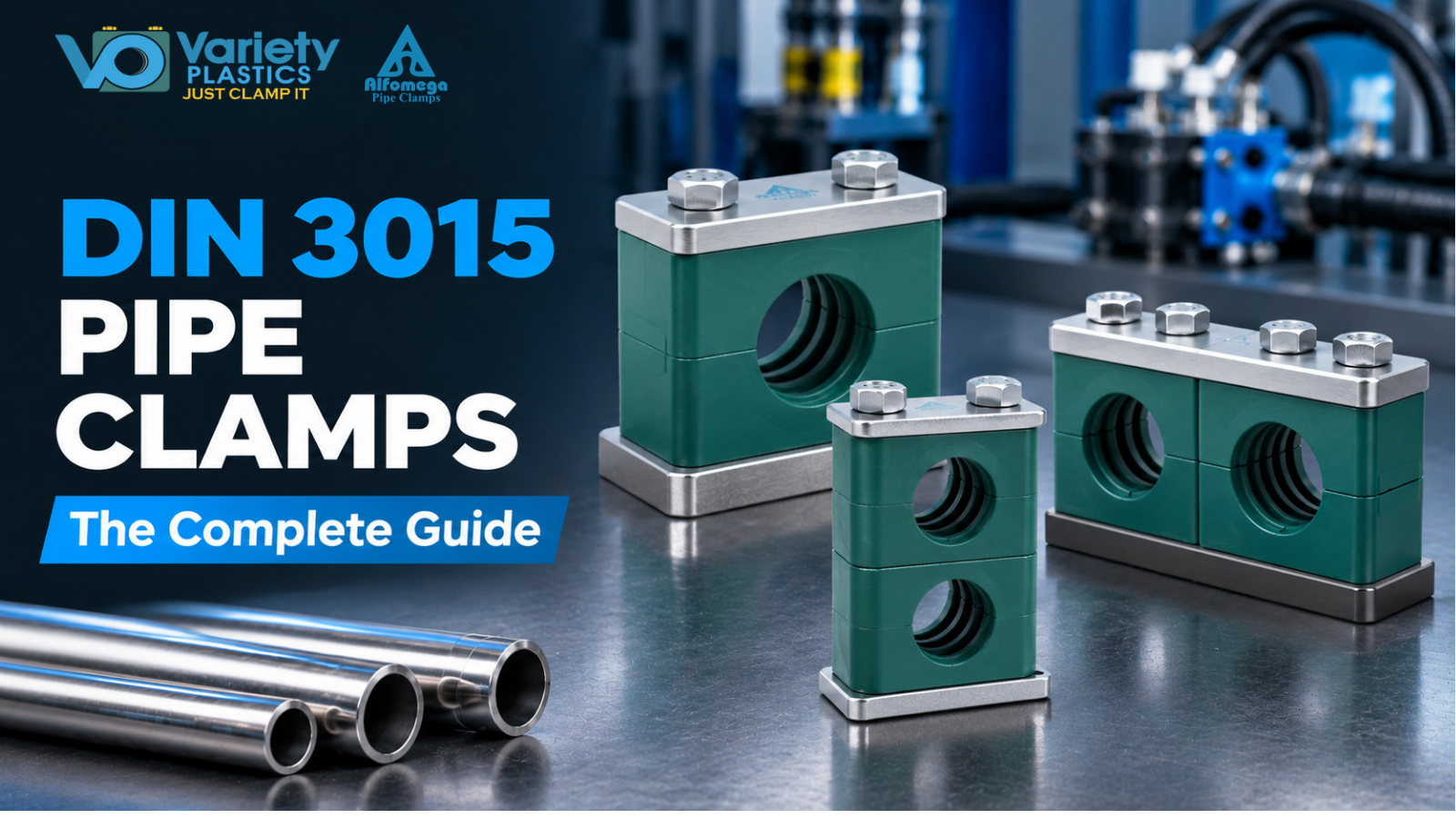
DIN 3015 is a dimensional standard associated with clamp assemblies for securing pipes and tubes. In practice, an assembly may include shaped clamp halves, a mounting plate or rail arrangement, bolts, and a cover plate. The components work together to locate the line and restrain unwanted movement. The standard helps buyers and designers communicate about families of clamp geometry, but it does not eliminate the need to verify the exact assembly and its suitability for a particular installation.
Do not confuse a pipe clamp with a pressure-containing fitting. The hydraulic tube, hose, fittings, and seals must independently meet the system's pressure and fluid requirements. A clamp supports the line; it does not make an otherwise unsuitable hydraulic connection safe.
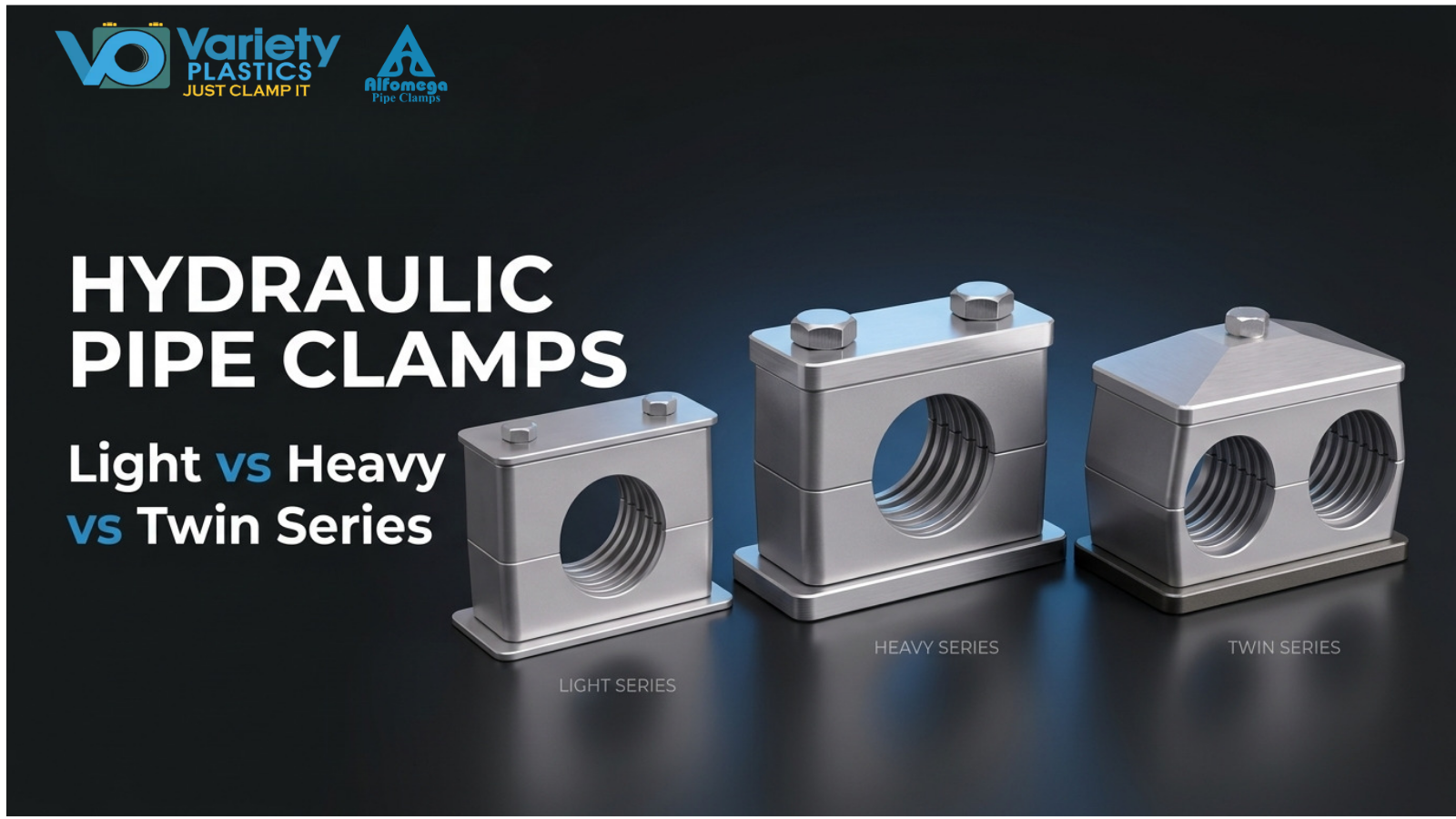
Light, Heavy and Twin Series: What Changes?
Light Series for compact line support
Light Series clamps are often considered for general hydraulic tubing and other installations where compact geometry is valuable. They can help route individual lines along machine frames and panels. Selection still depends on pipe diameter, expected movement, mounting spacing, and actual load—not simply whether the equipment is called “light duty.”
Heavy Series for demanding installations
Heavy Series assemblies use a more substantial configuration for applications that need greater mechanical support. They may be relevant to construction machinery, industrial power units, and equipment exposed to pronounced vibration or shock. The appropriate assembly, fasteners, and mounting surface must be assessed together; “heavy” is not a universal pressure rating.
Twin Series for paired lines
Twin Series clamps support two lines in one assembly, helping organize parallel hydraulic routes. This can be useful when a machine has paired supply and return tubes. Check both outside diameters, the spacing between lines, and access for future servicing before choosing a twin configuration.
How to Select the Correct Clamp Size
Begin with the outside diameter of the tube or pipe—not the nominal bore or the thread size of a fitting. Check whether the line is rigid tubing, pipe, or a hose that needs a different style of restraint. Compare the outside diameter with the manufacturer's drawing and bore options. If an unusual diameter or a custom insert is required, confirm feasibility before placing an order.
Next, look at the route. Where will the clamp sit relative to bends, fittings, valves, and moving components? Can a technician reach the bolts without removing adjacent equipment? Is there room for thermal expansion or expected movement? A clamp layout should secure the line without creating concentrated stresses or obstructing maintenance.
Finally, verify the full assembly: clamp body, cover plate, mounting plate or rail, bolts, and any other specified hardware. A correctly sized clamp body paired with unsuitable fasteners or an inadequate mounting surface can undermine the installation.
Materials Used in Industrial Pipe Clamps
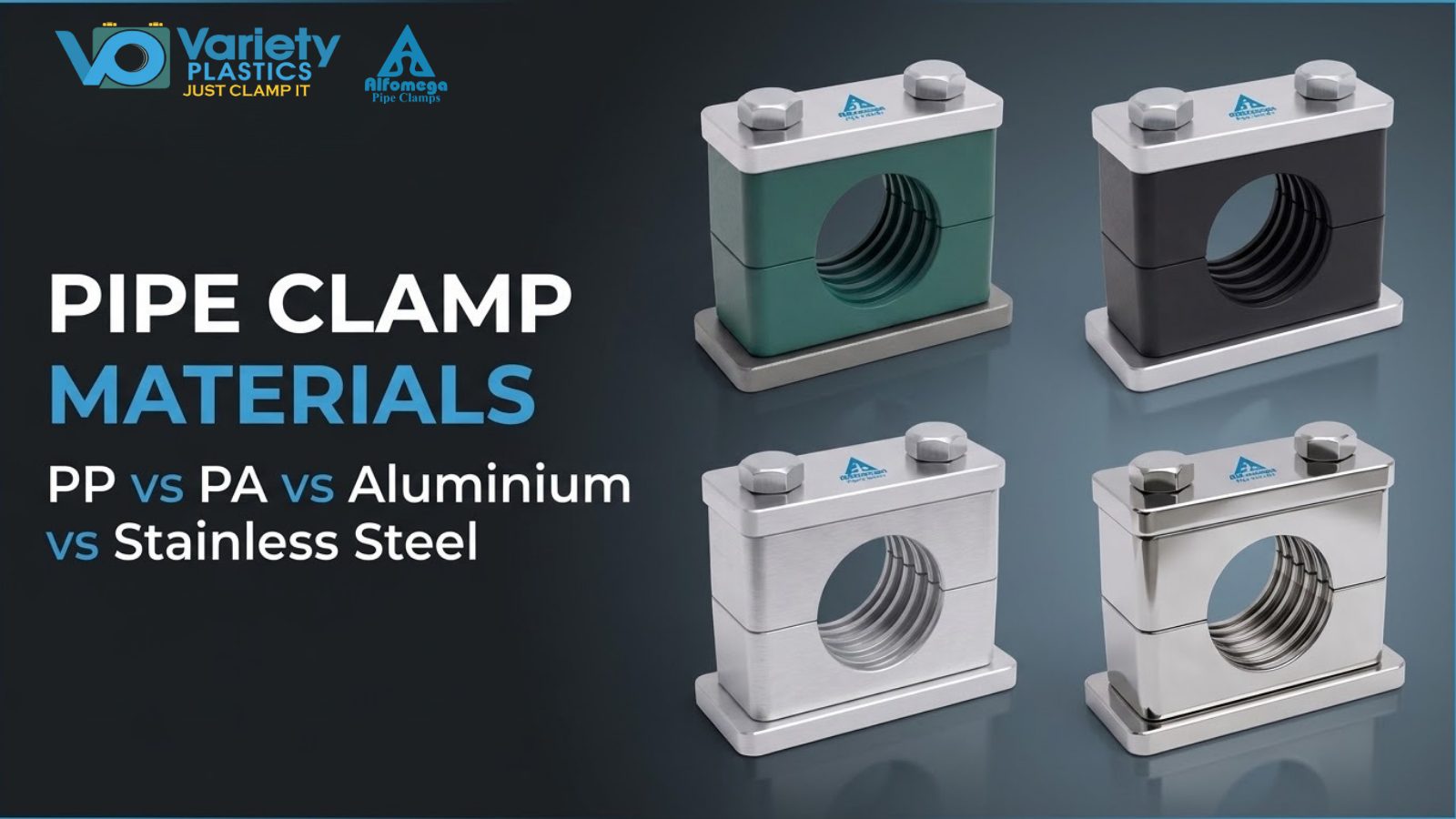
Polypropylene (PP) is a common option for general industrial applications where its temperature and chemical limits are suitable. Polyamide (PA) can offer different mechanical and thermal characteristics depending on grade and conditioning. Aluminium is a metal option for environments where its strength, weight, and thermal properties are advantageous. Stainless steel, including appropriate 304 or 316 grades, may be considered when corrosion resistance is important.
No material is universally best. Temperature, chemicals, moisture, UV exposure, mechanical load, and hardware compatibility all affect the decision. Verify the exact material grade and technical data rather than relying on a generic description such as “chemical resistant.”
Where Are DIN 3015 Clamps Used?
Common application areas include hydraulic power units, machine tools, construction equipment, agricultural machinery, process equipment, and industrial pipe-routing assemblies. Marine and chemical environments introduce additional corrosion and compatibility considerations. The goal is a line arrangement that is stable, inspectable, and practical to maintain.
A useful design review looks at the complete pipe run, not just individual clamp locations. Consider vibration sources, adjacent components, service access, and possible movement under operating conditions. Clamp spacing and orientation should follow the equipment designer's requirements and relevant engineering guidance.
Common Mistakes to Avoid
A frequent error is ordering by nominal pipe size without checking outside diameter. Another is choosing the material based only on purchase price. Installers can also overlook the mounting hardware, place clamps too close to fittings, or assume one clamp family suits every line in a system. Avoid unsupported claims about vibration reduction percentages or maximum pressure unless verified test data applies to the exact product and assembly.
Frequently Asked Questions
Are DIN 3015 clamps only for hydraulic pipes?
No. They are widely associated with hydraulic tubing, but suitable assemblies may also be used for other industrial pipe and tube support applications.
Can I replace a Light Series clamp with a Heavy Series clamp?
Not automatically. The mounting dimensions, geometry, line clearance, and installation requirements may differ. Compare drawings and obtain engineering approval.
What information should I send to a pipe clamp manufacturer?
Send the tube outside diameter, quantity, series or application, operating environment, mounting preference, and any relevant drawings.
Does DIN 3015 specify my system's pressure rating?
No. A clamp is a support component, not a substitute for correctly rated tubing, hoses, and fittings.
Questions to Ask Before Ordering
A useful quotation request is more than a product name. Share the outside diameter of the pipe or tube, the number of lines, the installation orientation, the material preference, and the mounting surface. Include drawings or photographs when retrofitting an existing machine. If the assembly will face unusual heat, chemicals, salt exposure, shock, or repeated maintenance, explain those conditions rather than assuming a standard catalogue item will be appropriate.
For OEM orders, provide the expected quantity, desired delivery schedule, preferred hardware finish, and any inspection or documentation requirements. This information helps a manufacturer confirm availability and identify a suitable configuration. A clamp that fits dimensionally may still need a different material or mounting arrangement for the operating environment.
Why Work With Variety Plastics?
Variety Plastics manufactures industrial hydraulic pipe clamps in Sidhpur, Gujarat, India, under the ALFOMEGA brand. Its published range covers DIN 3015-based Light, Heavy, and Twin Series clamps, several clamp materials, mounting options, and protective accessories. For equipment manufacturers and industrial procurement teams, a focused product range can simplify discussions about repeat orders, dimensions, and application-specific requirements.
Instead of selecting by appearance alone, ask for the relevant technical drawing, available size range, assembly components, and material specification. Product suitability should be confirmed against actual service conditions. Explore the Variety Plastics product range or contact the team for a quotation. The publishing agent should replace homepage fallback links with the verified product and enquiry URLs.