Choosing between Light, Heavy and Twin Series clamps sounds straightforward until you begin laying out a real hydraulic system. A compact machine may contain lines exposed to strong vibration. A large installation may have relatively gentle service conditions. Two adjacent tubes might benefit from a shared mounting point—or require separate access for maintenance. Understanding hydraulic pipe clamp types helps designers avoid choosing by name alone.
This comparison is written for OEM engineers, maintenance teams, industrial buyers, and procurement specialists evaluating ALFOMEGA clamps manufactured by Variety Plastics.
Why Clamp Series Matter
A clamp is part of the support strategy for a hydraulic line. It helps locate tubing and limit unwanted movement relative to the machine frame. The series affects geometry, how many lines can be held, the space required, and the mounting hardware used. It is not a shortcut for determining safe working pressure or guaranteed vibration performance.
The correct decision starts with the line layout and the forces the installation may experience. Consider movement, shock, temperature, accessibility, and the structural strength of the mounting surface. When those conditions are unclear, request technical guidance rather than substituting one series for another.
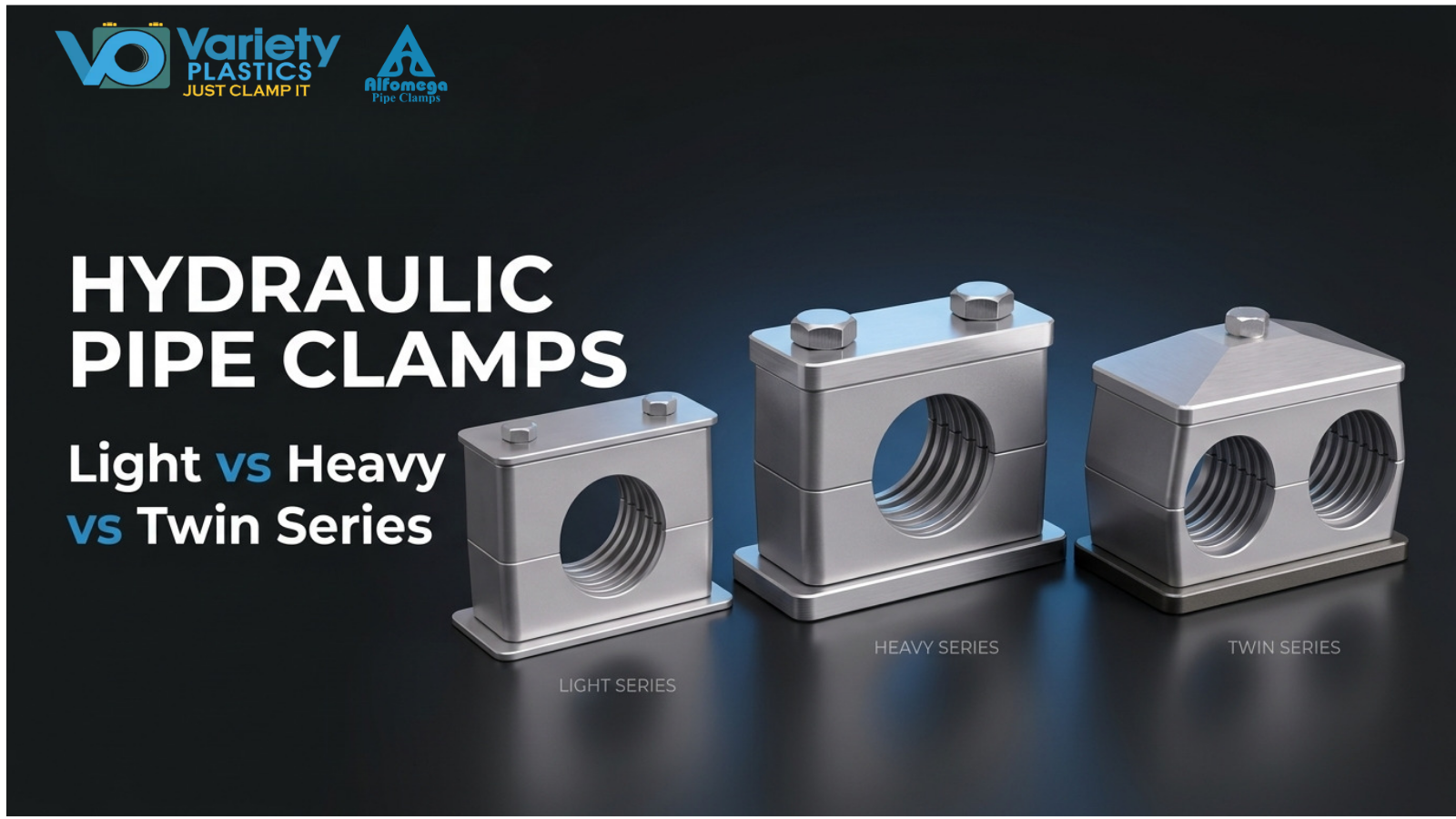
Light Series Pipe Clamps
Light Series clamps are commonly chosen for compact support arrangements and general industrial hydraulic tubing. Their relatively compact assembly can make them attractive where space is limited or several lines run close to a machine frame.
When Light Series may fit
Examples include hydraulic power packs, machine-tool tubing, and protected equipment panels. A line with modest movement and a well-designed support route may not need a bulkier assembly. However, the line diameter, fixing arrangement, and environmental conditions must be checked against product drawings.
What to verify
Check the outside diameter, assembly height, bolt access, base plate dimensions, and compatibility with nearby lines. Do not assume a Light Series clamp is appropriate simply because the pipe diameter is small; the operating environment may demand a different support approach.
Heavy Series Pipe Clamps
Heavy Series clamps are intended for more demanding mechanical support arrangements. Their larger or more robust assembly format can be useful where the design must address higher mechanical loads, vibration, or shock.
Typical application scenarios
Construction equipment, heavy industrial machines, and hydraulic installations near moving equipment may call for a more substantial clamp assembly. The decision should follow the expected loading and the manufacturer's technical data rather than a general label such as “high pressure.”
What to verify
A Heavy Series clamp still relies on correct fasteners, mounting plates, and supporting structure. Review the complete assembly, not just the polymer block. Make sure there is sufficient installation space and that the clamp will not interfere with adjacent hoses, covers, or service tools.
Twin Series Pipe Clamps
Twin Series clamps hold two lines together in a coordinated arrangement. They can simplify routing and reduce the number of separate support points in some layouts. This is especially relevant when supply and return tubes follow a parallel path.
Where Twin Series helps
Twin arrangements can create a tidy, repeatable pipe route in hydraulic manifolds, machine frames, and power units. They may also make assembly planning easier for production teams working from standard drawings.
What to verify
Confirm the outside diameter of each line, spacing, temperature exposure, and whether one line may need independent replacement. A shared clamp is not always ideal when tubes move differently or when maintenance access is restricted.
Light vs Heavy vs Twin: Quick Comparison
| Selection factor | Light Series | Heavy Series | Twin Series |
|---|---|---|---|
| Basic arrangement | Single-line compact support | Single-line robust support | Two-line support |
| Main design advantage | Space-efficient installation | More substantial assembly | Organized parallel routing |
| Key check | Available space and loads | Mechanical loads and hardware | Both line diameters and spacing |
| Typical buying question | Will it fit the layout? | Is the support robust enough? | Should these lines share a clamp? |
These are general distinctions, not performance guarantees. Compare the exact ALFOMEGA product drawing and specified components before final selection.
A Five-Step Selection Workflow
Step 1: Record line dimensions. Measure outside diameters and identify whether the lines are rigid tubes, pipes, or flexible hoses.
Step 2: Map the route. Mark bends, fittings, potential movement, heat sources, and service access. Look for places where supports can attach to sound structural members.
Step 3: Evaluate mechanical conditions. Note vibration sources, shock loads, temperature cycles, and environmental exposure. A line's pressure rating alone does not determine the clamp series.
Step 4: Choose the assembly. Compare Light, Heavy, and Twin drawings, then check the required plates, bolts, and rails.
Step 5: Confirm with the supplier. Send the selected series, diameter, quantity, material, and installation details for review before a bulk order.
Mistakes That Increase Maintenance Work
One mistake is treating the series name as a substitute for calculations or technical drawings. Another is selecting a twin clamp only to save space, without checking whether the two lines need different service access. Buyers sometimes specify a clamp body but omit mounting hardware from the bill of materials. Finally, replacing an existing clamp with a different series without reviewing the hole pattern can create unnecessary rework.
Frequently Asked Questions
Which hydraulic pipe clamp is best for high-pressure systems?
The correct series depends on mechanical support needs, line size, installation geometry, and manufacturer guidance. The pressure rating of the hydraulic line is a separate consideration.
Are Twin Series clamps always more space-efficient?
They can be for parallel lines, but the benefit depends on the exact layout, pipe spacing, and service access.
Can I use different clamp series on one machine?
Yes, where the design calls for different support arrangements. Each location should be evaluated on its own requirements.
Does Variety Plastics offer all three series?
Its published ALFOMEGA range includes Light, Heavy, and Twin Series DIN 3015-based clamps. Confirm current sizes and availability when requesting a quotation.
Questions to Ask Before Ordering
A useful quotation request is more than a product name. Share the outside diameter of the pipe or tube, the number of lines, the installation orientation, the material preference, and the mounting surface. Include drawings or photographs when retrofitting an existing machine. If the assembly will face unusual heat, chemicals, salt exposure, shock, or repeated maintenance, explain those conditions rather than assuming a standard catalogue item will be appropriate.
For OEM orders, provide the expected quantity, desired delivery schedule, preferred hardware finish, and any inspection or documentation requirements. This information helps a manufacturer confirm availability and identify a suitable configuration. A clamp that fits dimensionally may still need a different material or mounting arrangement for the operating environment.
Why Work With Variety Plastics?
Variety Plastics manufactures industrial hydraulic pipe clamps in Sidhpur, Gujarat, India, under the ALFOMEGA brand. Its published range covers DIN 3015-based Light, Heavy, and Twin Series clamps, several clamp materials, mounting options, and protective accessories. For equipment manufacturers and industrial procurement teams, a focused product range can simplify discussions about repeat orders, dimensions, and application-specific requirements.
Instead of selecting by appearance alone, ask for the relevant technical drawing, available size range, assembly components, and material specification. Product suitability should be confirmed against actual service conditions. Explore the Variety Plastics product range or contact the team for a quotation. The publishing agent should replace homepage fallback links with the verified product and enquiry URLs.