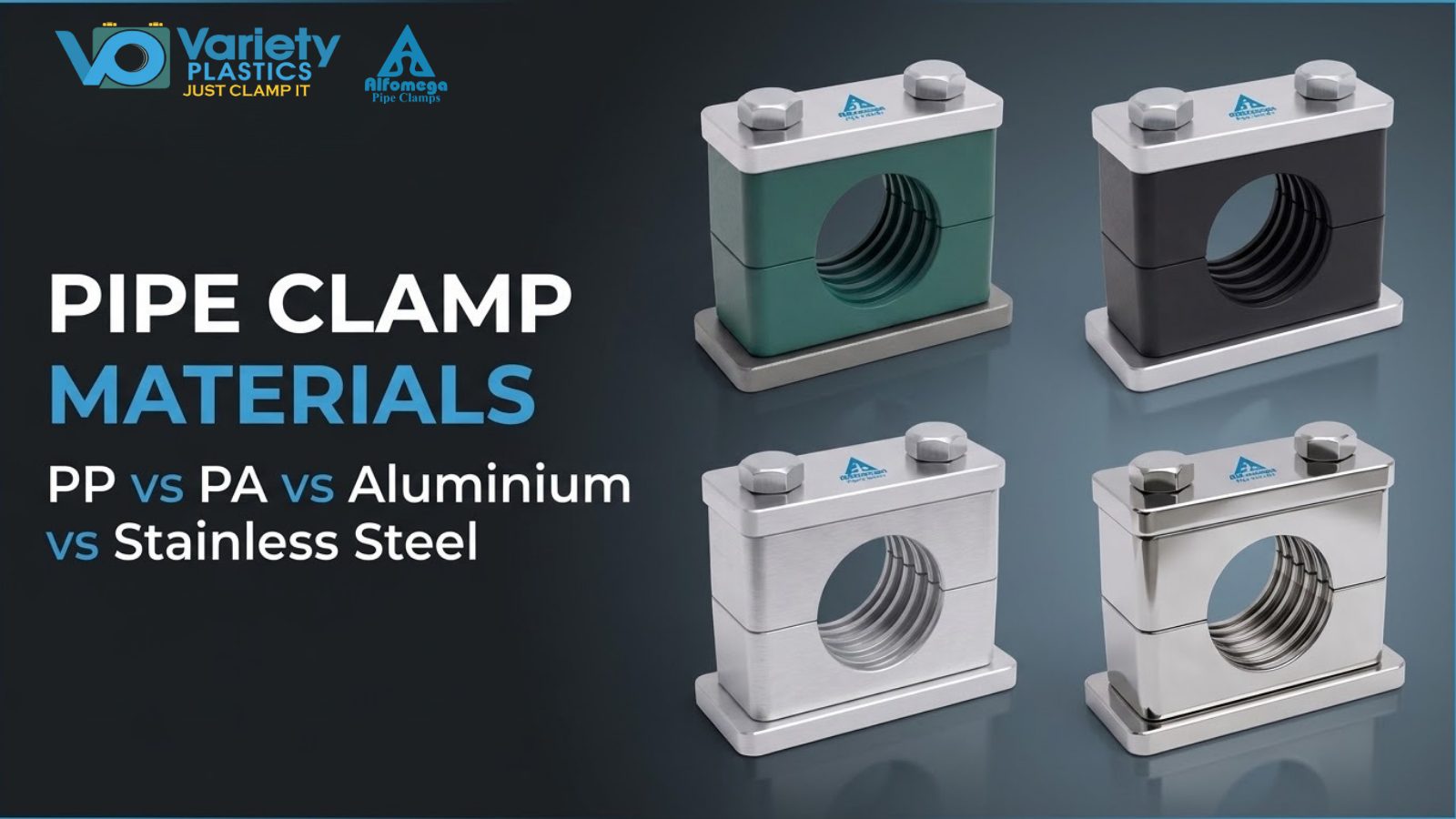
The same pipe clamp design can behave differently when made from a different material. A polymer that performs well in a protected factory may not be the first choice for prolonged heat exposure. A metal clamp suited to one chemical environment may corrode in another. That makes pipe clamp material comparison a practical part of hydraulic system design—not simply a purchasing exercise.
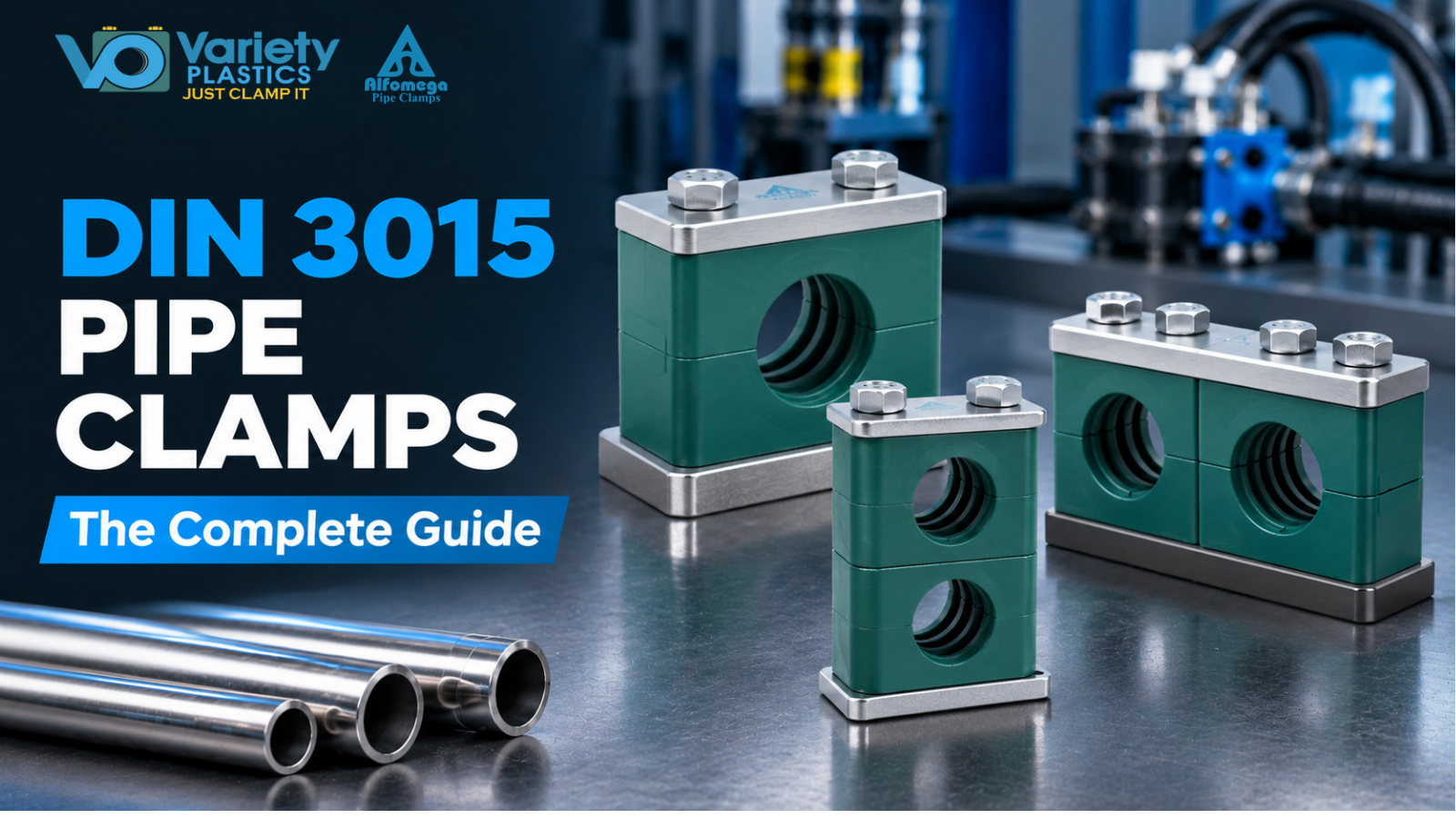
Variety Plastics lists polypropylene, polyamide, aluminium, and stainless steel options in its ALFOMEGA industrial clamp range. Here is how to think through those options without assuming that any material is suitable for every application.
Start With the Service Conditions
Before comparing materials, write down the expected minimum and maximum temperatures, fluids and cleaning chemicals, moisture exposure, outdoor conditions, mechanical loads, and whether electrical isolation matters. Include the mounting hardware in this review. A stainless clamp body combined with unsuitable fasteners may not deliver the corrosion performance a buyer expects.
Material grades are important. “Polyamide” can refer to different formulations and moisture conditions. “Stainless steel” can refer to grades with significantly different corrosion behavior. Always request the exact grade and relevant technical information.
Polypropylene (PP) Pipe Clamps
Polypropylene is widely used for industrial plastic components because it is lightweight, readily moulded, and compatible with many common service environments. PP clamp halves can provide a practical option for general hydraulic line support where temperatures, chemicals, and mechanical loads fall within the selected product's limits.
Advantages of PP
PP is relatively lightweight and can be manufactured in repeatable geometries. It also does not rust like carbon steel. For many indoor industrial installations, those characteristics can make it an economical and practical material choice.
Points to check
Polypropylene has temperature and load limits, and its behavior can change with prolonged heat, UV exposure, and specific chemicals. Avoid assuming that all PP grades perform identically. Confirm the product's operating range and long-term suitability before specifying it for a demanding installation.
Polyamide (PA) Pipe Clamps
Polyamide is another engineering polymer used in industrial components. Depending on grade and conditioning, it can provide useful strength, toughness, and wear characteristics. It may be considered where the application requires a different balance of mechanical properties from polypropylene.
Advantages of PA
A suitable polyamide grade can be useful in installations involving repeated handling or mechanical stress. Its engineering properties make it worth evaluating for machinery and equipment support components.
Points to check
Some polyamides absorb moisture, which can affect dimensions and mechanical properties. Temperature, chemical exposure, and the specific PA grade must be reviewed. Do not assume that polyamide automatically outperforms polypropylene in every operating condition.
Aluminium Pipe Clamps
Aluminium provides a metal option with relatively low density compared with steel and good thermal conductivity. Its suitability depends on alloy, surface treatment, environmental exposure, and assembly design.
Where aluminium may make sense
Aluminium may be considered for equipment where a metal clamp is preferred and weight or thermal characteristics matter. Industrial machinery and certain marine-related installations may use aluminium components, but the specific alloy and corrosion environment are decisive.
Points to check
Aluminium can experience galvanic corrosion when combined with dissimilar metals in conductive environments. Surface finish, fastener selection, and contact with the supported pipe deserve attention. The fact that a clamp is metallic does not by itself establish a higher allowable load.
Stainless Steel Pipe Clamps: 304 vs 316
Stainless steel is often selected when corrosion resistance is a major design factor. Grades 304 and 316 are common industrial choices, but they are not interchangeable in every environment.
Grade 304
304 stainless steel is used in many general industrial applications where its corrosion resistance is sufficient. It may be appropriate for clean indoor or moderately exposed environments, depending on the contaminants present.
Grade 316
316 stainless steel contains molybdenum, which generally improves resistance to certain chloride-related corrosion mechanisms compared with 304. This can make it worth evaluating for coastal, marine, and chemically exposed settings. It is not immune to corrosion, and severe chloride exposure still requires careful engineering review.
Material Comparison at a Glance
| Material | Common reason to consider it | Important limitation to verify |
|---|---|---|
| Polypropylene (PP) | Lightweight, general industrial use | Heat, UV, chemical and long-term load limits |
| Polyamide (PA) | Engineering-polymer toughness | Moisture conditioning and grade-specific properties |
| Aluminium | Lightweight metal construction | Alloy, galvanic corrosion and surface treatment |
| Stainless steel 304 | General corrosion-resistant metal | Chlorides and specific chemical exposure |
| Stainless steel 316 | Improved resistance in some chloride environments | Still requires corrosion and cost assessment |
This table is a screening aid, not a material specification or substitute for product datasheets.
How to Choose the Right Material
Begin by ruling out materials that are incompatible with the operating temperature or chemicals. Then consider mechanical loads, vibration, weight, expected life, and maintenance access. Compare the entire assembly, including bolts, plates, and rails. Where a machine operates outdoors, assess UV, rainwater, salt, and thermal cycling rather than choosing based on one property.
For large OEM purchases, consider trial installation and approval of a representative sample. Verify fit and assembly requirements before committing to volume production. A small amount of application testing can prevent costly changes later.
Frequently Asked Questions
Is polyamide always stronger than polypropylene?
No. Performance depends on the exact grades, conditioning, temperature, and loading conditions. Compare supplier data for the intended use.
Are stainless steel clamps rustproof?
No metal is universally immune to corrosion. Stainless steel grades offer different levels of resistance, and environmental conditions matter.
Can aluminium clamps be used near seawater?
Potentially, but suitability depends on the alloy, coatings, galvanic interactions, and exposure. Request engineering confirmation.
Which material should I choose for a hydraulic power unit?
There is no single answer. Consider temperature, fluid exposure, vibration, installation design, and the manufacturer's product data.
Questions to Ask Before Ordering
A useful quotation request is more than a product name. Share the outside diameter of the pipe or tube, the number of lines, the installation orientation, the material preference, and the mounting surface. Include drawings or photographs when retrofitting an existing machine. If the assembly will face unusual heat, chemicals, salt exposure, shock, or repeated maintenance, explain those conditions rather than assuming a standard catalogue item will be appropriate.
For OEM orders, provide the expected quantity, desired delivery schedule, preferred hardware finish, and any inspection or documentation requirements. This information helps a manufacturer confirm availability and identify a suitable configuration. A clamp that fits dimensionally may still need a different material or mounting arrangement for the operating environment.
Why Work With Variety Plastics?
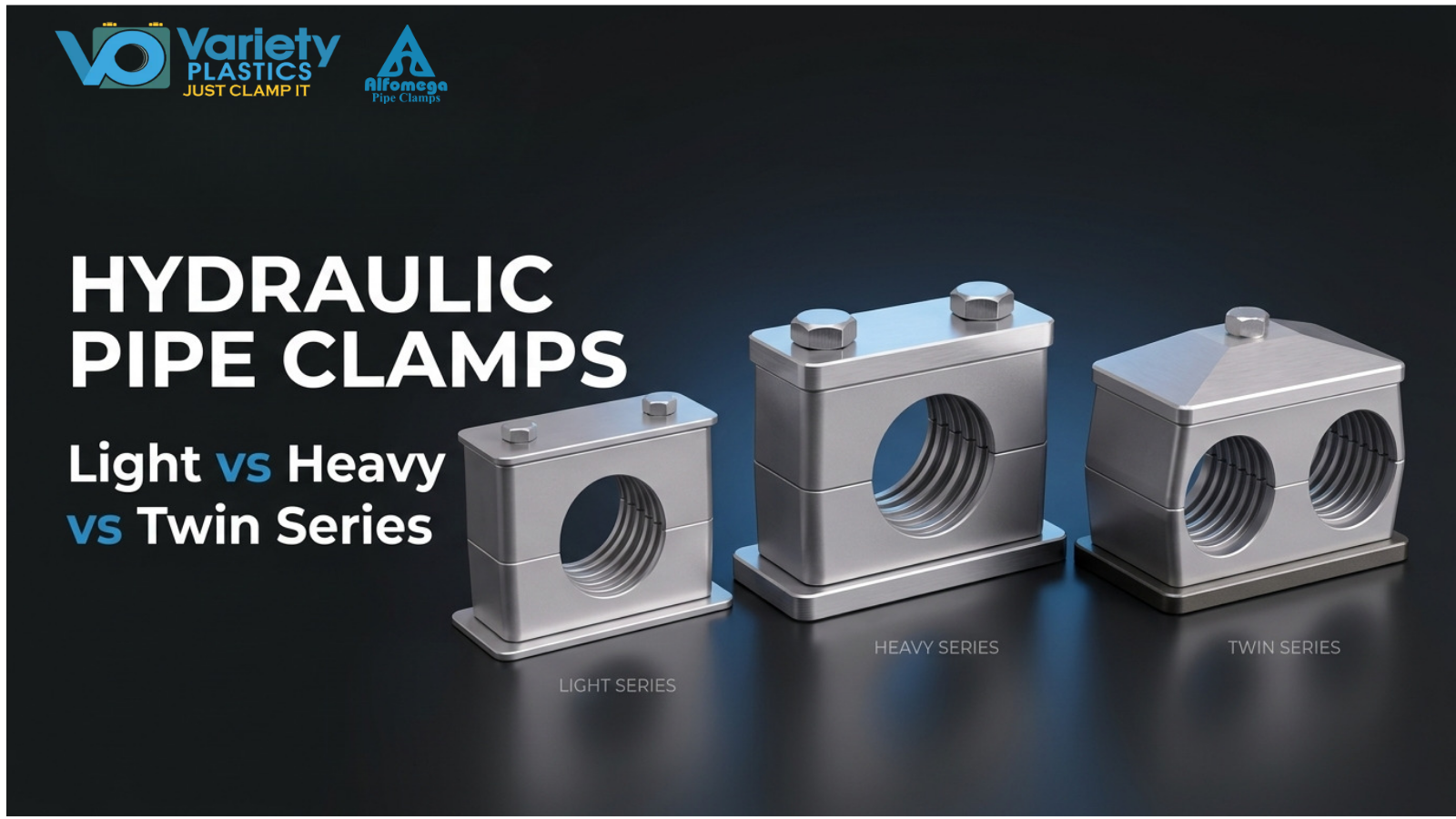
Variety Plastics manufactures industrial hydraulic pipe clamps in Sidhpur, Gujarat, India, under the ALFOMEGA brand. Its published range covers DIN 3015-based Light, Heavy, and Twin Series clamps, several clamp materials, mounting options, and protective accessories. For equipment manufacturers and industrial procurement teams, a focused product range can simplify discussions about repeat orders, dimensions, and application-specific requirements.
Instead of selecting by appearance alone, ask for the relevant technical drawing, available size range, assembly components, and material specification. Product suitability should be confirmed against actual service conditions. Explore the Variety Plastics product range or contact the team for a quotation. The publishing agent should replace homepage fallback links with the verified product and enquiry URLs.