A hydraulic pump can only perform reliably when its inlet and outlet connections are correctly designed. The wrong connection flange may leak, restrict suction flow, loosen under vibration or fail to align with the pump body. For machinery builders and maintenance teams, choosing the right Dowty pump flange is therefore a practical engineering decision, not a matter of matching a thread size alone.
In many industrial catalogues, a Dowty pump flange refers to a bolted connection adaptor used with hydraulic gear pumps. It presents an external pipe or hose connection, often a BSP parallel female thread, while a sealing arrangement at the pump face prevents oil escaping at the bolted joint. This guide explains what to check when comparing flange sizes, pump groups, seal types and installation requirements.
What is a Dowty pump flange?
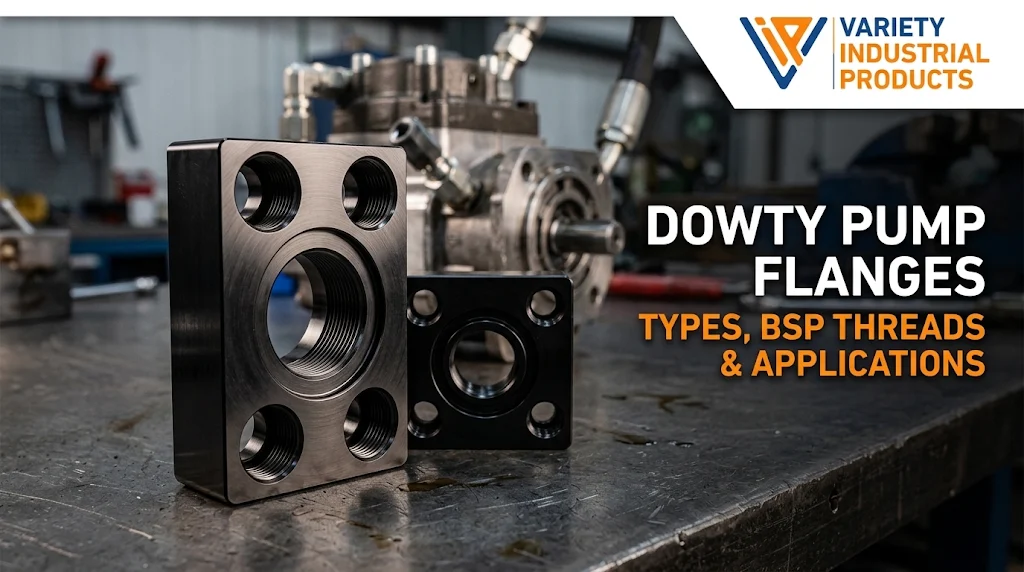
A Dowty pump flange is a hydraulic pump connection component used to join the port face of a compatible pump to downstream pipework or hose fittings. The flange body commonly has a bolted mounting pattern on one side and a threaded connection on the other. A suitable seal between the pump and flange prevents fluid leakage across the mating faces.
The term Dowty is widely used in hydraulic component sourcing, but buyers should not assume that every flange carrying the name fits every Dowty-branded or other manufacturer's pump. Pump geometry, fixing pattern, port location, thread form and pressure rating need explicit confirmation. In practice, ordering by exact drawing or part number is more dependable than ordering by a familiar product nickname.
The connection may be placed on the pump's pressure delivery port or suction inlet, provided it is designed for that location. Suction and pressure sides can require different flow areas and sealing considerations. A flange suitable for a modest delivery connection should not automatically be treated as suitable for a larger suction opening.
How does a hydraulic pump connection flange work?
The pump body contains machined fluid ports. The flange bolts to the corresponding pad with an engineered seal at the interface. On the outer side, its pipe thread provides a connection for the correct adaptor or hose fitting. The complete assembly transfers fluid between the pump and the hydraulic circuit while maintaining the required sealing and mechanical support.
Pressure-side flange function
On the delivery side, the flange must withstand the system's applicable operating pressure and pressure transients. Mechanical fastening and seal compression are both important. The pressure rating of a pump flange should be confirmed for its exact model and installation, including the connected fitting and mating pump port.
Suction-side flange function
On the inlet side, minimizing restriction is critical. Excessive inlet pressure drop can contribute to pump cavitation and aeration. The inlet flange and connected hose must be adequately sized for the pump flow, oil viscosity and installation conditions. An air leak on the suction line may not produce an obvious external oil leak, but can still create operating problems.
Why the seal matters
The sealing arrangement between the pump face and flange must match the manufacturer's design. A bonded sealing washer, sometimes called a Dowty washer, consists generally of a metal washer with an elastomeric sealing element. Where this arrangement is specified, the mating geometry and compression need to suit it. Other pumps use O-rings or different face-sealing methods, so a bonded washer should not be substituted without engineering approval.
Understanding BSP and BSPP threaded pump flanges
BSP refers to British Standard Pipe thread families. For many industrial hydraulic components, BSPP denotes a parallel thread, commonly designated with a G prefix under ISO 228-1. A parallel thread generally requires an appropriate separate sealing method; thread engagement alone should not be assumed to provide a pressure-tight joint.
A G 1/2 BSPP thread and a G 3/4 BSPP thread are different nominal sizes. The nominal designation does not directly indicate a measured bore diameter, so buyers should rely on the defined thread standard and a manufacturer's drawing. Also, BSPP and BSPT are not the same thread form. Mixing pipe-thread families or assuming interchangeability with NPT can cause damaged fittings and leakage.
When asking for a BSP threaded pump flange, specify the full connection form rather than simply saying “half-inch hydraulic flange.” Include thread family, size, fitting seal type, pump-port drawing and service conditions. These details help the supplier avoid selecting an apparently similar but incompatible component.
Common Dowty pump flange sizes
Variety Industrial Products publishes several female BSPP pump flange variants, including 1/2 inch, 3/4 inch, 1 inch and 1¼ inch. These are examples from the company's product range; actual dimensions and allowable pressures vary by model. The exact flange should be selected through the published product specifications, not solely from the thread size.
| Published product family | Female connection | Typical sourcing question |
|---|---|---|
| Small connection flange | G 1/2 BSPP | Does the bolt pattern match the pump port? |
| Medium connection flange | G 3/4 BSPP | Is it intended for suction or delivery? |
| Larger connection flange | G 1 BSPP | What are the port opening and sealing dimensions? |
| Large connection flange | G 1¼ BSPP | Is the inlet flow area adequate for the pump? |
A larger BSP thread does not automatically mean a higher pressure rating. Component wall thickness, geometry, material, seals and the attached system affect the permissible conditions. Always confirm the rating for the particular part number and the complete installation.
Four-bolt flanges and pump group compatibility
Hydraulic gear pumps may be categorized by manufacturer-specific group or frame sizes. Engineers often refer to group 1, group 2 and group 3 pumps, but these names alone do not define a universal flange geometry for every brand and product series. A four-bolt flange may look close to another model while having a different center distance, bolt diameter, port opening or sealing recess.
What dimensions should be checked?
Measure or obtain documented values for the flange's overall dimensions, bolt-hole size and center spacing, port location, seal seat and thread details. Also verify the available thread depth, screw engagement and clearance around nearby pump housings or mounting brackets. Compare these dimensions directly with the pump manufacturer's connection drawing.
Does a flange for one pump brand fit another?
Possibly, but compatibility must be proven. Even when pumps are marketed under a similar group designation, their port arrangements can vary. Do not state that a pump flange is interchangeable with another brand unless the approved drawings or manufacturer documentation establish the match.
Should the same flange be used on suction and delivery?
Not necessarily. The suction side may need greater flow area to avoid excessive inlet restriction. Some pumps have different port dimensions and bolt patterns for their inlet and outlet. The component selection should be based on the actual pump model and circuit design.
Materials and coatings for hydraulic pump flanges
Steel pump flanges are commonly chosen where strength, secure fastening and industrial durability are important. C45/EN8-type steel is among materials described in relevant hydraulic component catalogues, including Variety Industrial's published range. Materials should be approved for the part's geometry and working conditions; the use of steel alone does not establish a safe pressure rating.
Manufacturing quality matters because flatness, bolt-hole locations, counterbore geometry and thread accuracy affect fit. A badly positioned hole can place extra stress on the pump casing when fasteners are tightened. A damaged seal seat can create leakage even if the external thread is correct. Suitable inspection includes dimensional checks, thread gauges and surface inspection.
Black oxide or other surface treatments can provide specified corrosion protection for steel parts. However, the installed environment, protective oil, washing practices and storage conditions all affect long-term performance. Coating selection should be discussed along with the application, particularly for equipment operating outdoors or in corrosive atmospheres.
Selecting the right Dowty pump flange: an OEM checklist
1. Record the exact hydraulic pump model
Obtain the full manufacturer and model code, not just the nominal pump group. Retrieve the official drawing for the suction or delivery port that will be connected.
2. Identify the required port and thread
Specify suction or pressure side, BSPP thread size and mating fitting arrangement. Check that the opening is appropriate for required flow and that the external connection can be installed without interference.
3. Verify mounting geometry
Confirm bolt center distances, hole diameter, flange thickness, port position and sealing recess. Include the pump maker's fastener requirements where available.
4. Review pressure and fluid conditions
Record the working pressure, expected transients, fluid type and temperature range. Verify the flange model and seal are approved for the application. A nominal catalogue rating should not be carried over to a different size or custom design without confirmation.
5. Define sealing components
Confirm whether the flange uses a bonded washer, O-ring or another approved sealing method, and whether seals are included in the supply. Specify seal material and dimensions where needed. Reusing damaged sealing elements can compromise the assembly.
6. Consider hose loading and vibration
Plan the hose routing so the flange does not carry avoidable external bending or vibration loads. Suitable support of pipework can improve connection reliability. Check service access for reinspection and maintenance.
7. Include quantities and documentation in the RFQ
For production orders, provide annual volume, first batch quantity, delivery address, required drawing revision and inspection documents. For one-off replacements, supply clear part identification and dimensional details.
Installation precautions for hydraulic pump flanges
Pump-flange installation should follow the pump manufacturer's procedure and the approved system design. Before assembly, clean and inspect the pump pad, flange face, bolts and seal. Verify that threaded holes and surfaces are not damaged and that the selected seal matches the intended recess. Do not apply an arbitrary bolt torque: the appropriate value depends on fastener specification, materials, lubrication and the pump maker's instructions.
Tighten evenly using the approved sequence and calibrated tools. Connect pipework without forcing the flange or pump housing into alignment. Prime the pump and its suction circuit as required by the pump manufacturer's commissioning instructions, then verify operation under controlled conditions. A system should be inspected for leakage using safe methods; never use a hand to search for a high-pressure leak.
If a connection leaks, isolate the system and depressurize it before inspection. Investigate damaged seals, face scratches, incorrect geometry, fastener problems and external hose stress. Repeatedly tightening the joint without finding the cause can damage threads or pump components.
How pump flanges work with the rest of a hydraulic power pack
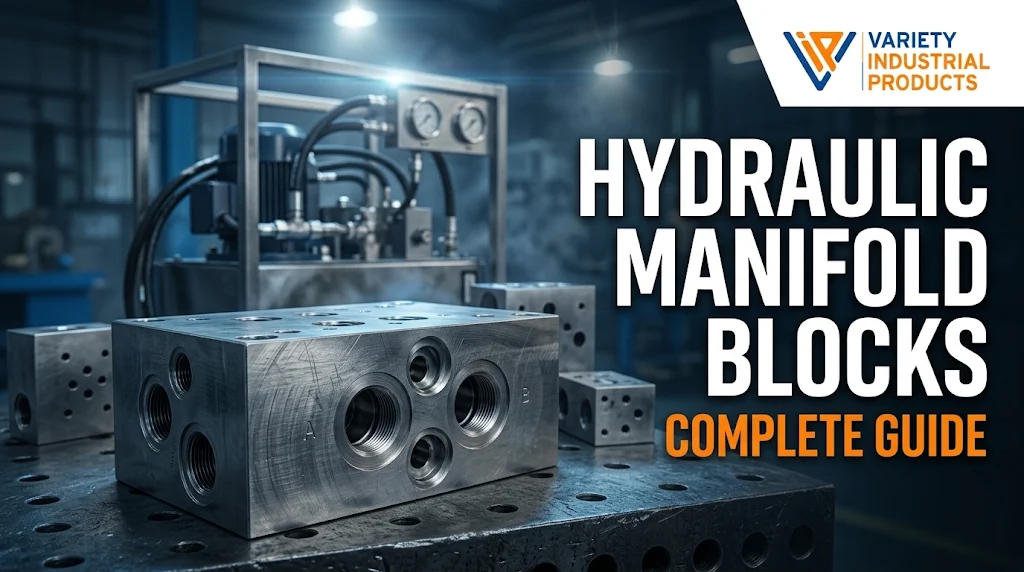
A gear pump supplies fluid to the pressure circuit, where a manifold can route oil through directional, pressure and flow-control valves. The pump connection flange is only one part of that path, but its correct selection helps support the complete system's integrity. The hydraulic manifold must also have suitable port sizes and pressure ratings, and the tank-return arrangement needs attention to flow and heat.
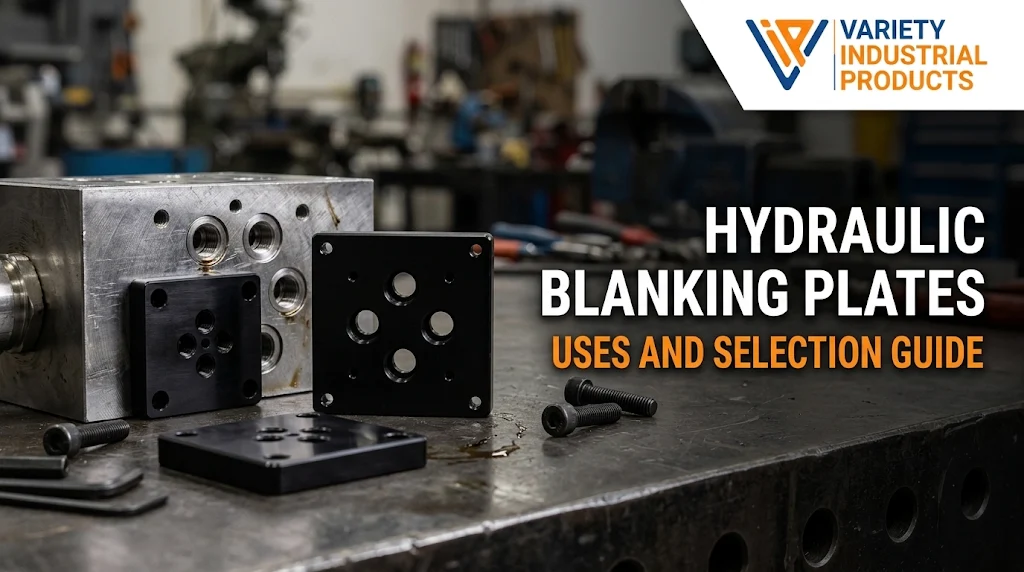
For this reason, pump flanges and manifolds are often specified together when designing a new hydraulic power unit. Our hydraulic manifold blocks guide explains the distribution function, while our custom hydraulic manifold manufacturing guide covers the drawing and production process. Where a manifold includes spare NG6 stations, the blanking plate selection guide may also be relevant.
Dowty pump flange manufacturing in India
Variety Industrial Products, based in Sidhpur, Gujarat, manufactures BSP-threaded Dowty pump connection flanges alongside hydraulic manifold blocks and blanking plates. Its published product information lists female BSPP sizes and dimensional details for selected flange models. The company focuses on CNC machining and hydraulic hardware for industrial and OEM customers.
If you are looking for a Dowty pump flange manufacturer in India, send the pump model, interface drawing, BSP connection size, application pressure, seal requirement and purchase quantity. The company's engineers can review the enquiry against its documented product options and discuss manufacturing requirements. View the Dowty pump flange product page or request a quotation.
Need Custom Machined Hydraulic Manifolds or Flanges?
Our Sidhpur, Gujarat facility manufactures standard NG6 CETOP 3 blocks, custom multi-station manifolds, blanking plates, and Dowty pump flanges up to 350+ BAR. Upload your 2D manufacturing drawings or STEP 3D models for an engineering feasibility review.
Frequently Asked Questions
What is a Dowty pump flange used for?
It provides a bolted connection between a compatible hydraulic pump port and downstream piping or hose fittings, using the intended sealing arrangement at the pump face.
What is the difference between BSP and BSPP?
BSP is a broader family term, while BSPP refers to parallel pipe threads. The sealing method and full standard must be specified for an accurate hydraulic connection.
Are Dowty pump flanges used on suction lines?
Some flange models are designed for suction connections. Selection must account for the pump's inlet geometry, flow requirement and acceptable inlet restriction.
Is a Dowty washer always included?
Not necessarily. Check whether the supplier provides a bare flange, a seal or a complete installation kit, and confirm the seal is suitable for the model.
Can I choose a flange using thread size alone?
No. Pump face geometry, mounting-hole locations, sealing method, pressure rating and suction or delivery function must also match.
Conclusion
A reliable Dowty pump flange is defined by more than its BSP thread. It must fit the pump body, provide the required sealing interface and withstand the application's mechanical and hydraulic conditions. Verified drawings and complete RFQ information are the best protection against compatibility errors. For BSP-threaded hydraulic pump connection flanges, explore Variety Industrial Products and contact the team through its RFQ page.